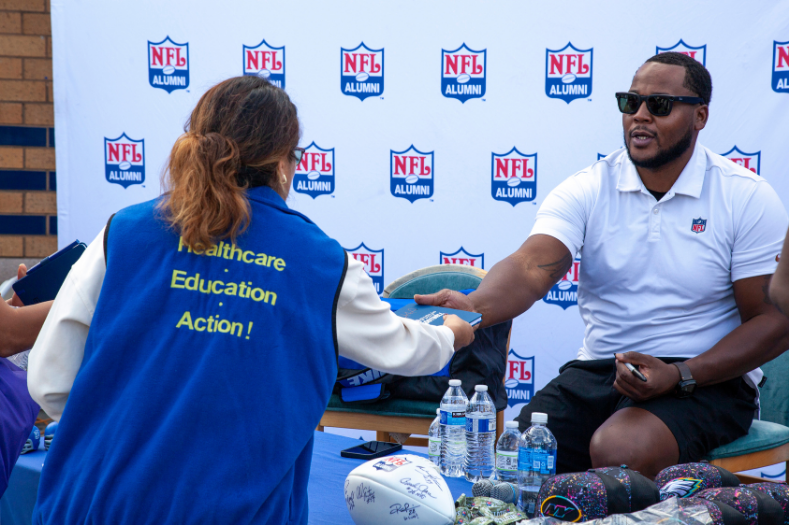
Healthcare organizations are investing heavily in community engagement today. They sponsor events. They run screenings. Many have built their own community engagement teams, staffed by community health workers, to represent them directly in the neighborhoods they're trying to reach.
This is real investment, not a lack of effort. It runs into a set of limits that compound on top of each other.
Community health workers produce real outcomes. A randomized trial published in Health Affairs found that an evidence based CHW program returned $2.47 to an average Medicaid payer for every dollar invested within the fiscal year. That result came from a caseload of about 55 patients per community health worker per year, built on close, sustained relationships.
That same closeness is the limit. A CHW managing 55 relationships well cannot also be at the church health fair, the barbershop screening, and the food pantry line happening the same week across a region.
The math makes the ceiling concrete. A health plan trying to close 10,000 hypertension care gaps, using that same caseload ratio, would need roughly 180 full-time community health workers dedicated to that single measure, on top of the supervisors, training, and management it takes to support them. Multiply that across every measure a health plan or health system is accountable for, and hiring enough CHWs to hit the goal directly is not realistic for almost any organization's budget or workforce.
Even where these events and screenings run digital sign-in sheets or online registration forms, capturing a name at the door was never the hard part. The hard part is what happens to that data next.
The growth team trying to build volume for a specific service line doesn't see it. The retention team trying to keep members enrolled through a redetermination cycle doesn't see it. The quality or care management team responsible for closing a specific care gap doesn't see it either. The event happened, the names were captured, and none of it reached the person whose job it is to move the number that event was supposed to support.
Even when a healthcare organization wants to work more closely with a community partner, exchanging member level information and documenting outcomes can become difficult.
Many community organizations do not have the systems, permissions, security controls, or legal agreements required to receive sensitive member information and return engagement data to a healthcare organization.
Asking every church, food pantry, or barbershop to build enterprise healthcare infrastructure is unrealistic. So organizations often default to the lowest risk interaction available: a generic flyer, a general event, and little exchange of information in either direction.
That is not a lack of ambition. It is a rational response to a gap neither side has been positioned to close on its own.
Compliance is not the only barrier to going deeper. Even where a healthcare organization is willing to work through the data questions, actually contracting with a real network of community partners raises a separate problem: procurement and insurance.
Meaningful reach means dozens or hundreds of small, local organizations, not five or six large ones. Most healthcare organizations aren't set up to negotiate and manage that many individual vendor contracts, and most small community organizations can't meet the general liability and other insurance requirements a healthcare organization's vendor policy asks of anyone performing services on its behalf. A barbershop or a food pantry rarely carries the kind of coverage a hospital system's procurement team would require from any other vendor.
That mismatch, real reach requires many small partners, while contracting and insurance requirements favor a handful of large ones, is enough on its own to keep most networks small.
More events and more CHWs can expand reach, but neither solves the underlying gap on its own. What's missing isn't just a data or compliance layer. It's the ability for a CHW team to train and oversee a much wider network of community partners, faith centers, food pantries andaffordable housing providers, who can drive engagement simultaneously across dozens of locations a CHW alone could never personally cover.
Closing that gap takes infrastructure that does four things: lets a CHW team coordinate and oversee a network of community partners instead of personally delivering every touchpoint, routes what actually happened back to the growth, retention, or care management team accountable for it, lets a healthcare organization share only what's needed without requiring a CBO to build its own HIPAA and HITRUST program from scratch, and removes the burden of negotiating and managing dozens of individual vendor agreements and insurance requirements directly.
That shift, from a CHW personally carrying a capped caseload to a CHW team overseeing a network that multiplies their reach, is what turns community engagement from an annual sponsorship into something a healthcare organization can run, trust, and fund like the growth channel it actually is.
---
CleanCut Health gives healthcare organizations the infrastructure to activate trusted community partners, fund their work, and verify the health actions that drive membership, retention, and preventive care.